Picture 1 of 2
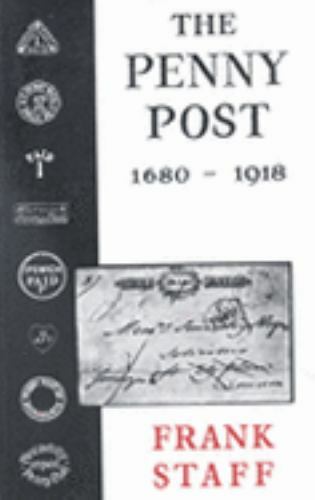
Stock photo


Picture 1 of 2
Stock photo

Penny Post : 1680-1918 by Frank Staff (1993, Trade Paperback)

World of Books USA (1229614)
96.3% positive feedback
Price:
$16.60
Free shipping
Returns:
30 days returns. Buyer pays for return shipping. If you use an eBay shipping label, it will be deducted from your refund amount.
Condition:
Book Binding:Paperback / softback. Author:Frank Staff. All of our paper waste is recycled within the UK and turned into corrugated cardboard. Need help?. World of Books USA was founded in 2005. Book Condition:VERYGOOD.
- Buy It NowThe Penny Post: 1680 - 1918 by Frank Staff Paperback Book The Fast Free Shipping
Oops! Looks like we're having trouble connecting to our server.
Refresh your browser window to try again.
About this product
Product Identifiers
PublisherLutterworth Press, T.H.E.
ISBN-10071882878X
ISBN-139780718828783
eBay Product ID (ePID)19038662003
Product Key Features
Book TitlePenny Post : 1680-1918
Number of Pages219 Pages
LanguageEnglish
TopicPublic Affairs & Administration, Modern / General
Publication Year1993
IllustratorYes
GenrePolitical Science, History
AuthorFrank Staff
FormatTrade Paperback
Dimensions
Item Weight13.5 Oz
Item Length8.5 in
Item Width5.4 in
Additional Product Features
Intended AudienceTrade
TitleLeadingThe
SynopsisTo some (such as Elihu Burritt who campaigned so vigorously for Ocean Penny Post to and from the United States, and Henniker Heaton, who by his efforts brought about Imperial Penny Post in 1898) the need to provide a cheap means of communication between peoples at home and abroad was not only obvious but was fought for with missionary zeal. However, governments were slow to react to these demands and the story Frank Staff describes provides a fascinating sidelight of social as well as postal history. While we are familiar with the name of Rowland Hill, who in 1840 established Uniform Penny Post in this country, less well-known is the pioneering work of William Dockwra, who created an efficient Penny Post in London as early as 1680 with four or five hundred Receiving Houses to take in letters, seven Sorting Offices and very frequent deliveries. Other pioneers include Ralph Allen of Bath, who developed Bye-way and Cross Roads Post throughout England and Wales in 1720, Peter Williamson, who organised a Penny Post in Edinburgh in 1773-4, and John Palmer, who devised the first mail-coach service in 1784 from Bristol to London. The study of postal history opens up wide possibilities and is a fascinating subject of interest to the social historian as well as the philatelist. The Penny Post not only gives the historical background of a reform, but indicates the range of items that may still be obtained by the keen collector - early date-stamped envelopes, broadsheets and pamphlets, letter scales and stamp boxes, personal correspondence and newspaper cartoons - and the book itself is illustrated with a remarkable collection of photographs and line drawings, To some (such as Elihu Burritt who campaigned so vigorously for Ocean Penny Post to and from the United States, and Henniker Heaton, who by his efforts brought about Imperial Penny Post in 1898) the need to provide a cheap means of communication between peoples at home and abroad was not only obvious but was fought for with missionary zeal., To some (such as Elihu Burritt who campaigned so vigorously for Ocean Penny Post to and from the United States, and Henniker Heaton, who by his efforts brought about Imperial Penny Post in 1898) the need to provide a cheap means of communication between peoples at home and abroad was not only obvious but was fought for with missionary zeal. However, governments were slow to react to these demands and the story Frank Staff describes provides a fascinating sidelight of social as well as postal history. While we are familiar with the name of Rowland Hill, who in 1840 established Uniform Penny Post in this country, less well-known is the pioneering work of William Dockwra, who created an efficient Penny Post in London as early as 1680 with four or five hundred Receiving Houses to take in letters, seven Sorting Offices and very frequent deliveries. Other pioneers include Ralph Allen of Bath, who developed Bye-way and Cross Roads Post throughout England and Wales in 1720, Peter Williamson, who organised a Penny Post in Edinburgh in 1773-4, and John Palmer, who devised the first mail-coach service in 1784 from Bristol to London. The study of postal history opens up wide possibilities and is a fascinating subject of interest to the social historian as well as the philatelist. The Penny Post not only gives the historical background of a reform, but indicates the range of items that may still be obtained by the keen collector - early date-stamped envelopes, broadsheets and pamphlets, letter scales and stamp boxes,personal correspondence and newspaper cartoons - and the book itself is illustrated with a remarkable collection of photographs and line drawings., To some (such as Elihu Burritt who campaigned so vigorously for Ocean Penny Post to and from the United States, and Henniker Heaton, who by his efforts brought about Imperial Penny Post in 1898) the need to provide a cheap means of communication between peoples at home and abroad was not only obvious but was fought for with missionary zeal. However, governments were slow to react to these demands and the story Frank Staff describes provides a fascinating sidelight of social as well as postal history. While we are familiar with the name of Rowland Hill, who in 1840 established Uniform Penny Post in this country, less well-known is the pioneering work of William Dockwra, who created an efficient Penny Post in London as early as 1680 with four or five hundred Receiving Houses to take in letters, seven Sorting Offices and very frequent deliveries. Other pioneers include Ralph Allen of Bath, who developed Bye-way and Cross Roads Post throughout England and Wales in 1720, Peter Williamson, who organised a Penny Post in Edinburgh in 1773-4, and John Palmer, who devised the first mail-coach service in 1784 from Bristol to London. The study of postal history opens up wide possibilities and is a fascinating subject of interest to the social historian as well as the philatelist. The Penny Post not only gives the historical background of a reform, but indicates the range of items that may still be obtained by the keen collector - early date-stamped envelopes, broadsheets and pamphlets, letter scales and stamp boxes, personal correspondence and newspaper cartoons - and the book itself is illustrated with a remarkable collection of photographs and line drawings., An authorative account of the growth of Penny Post from its local beginnings to national and international agreements.
All listings for this product


Be the first to write a review