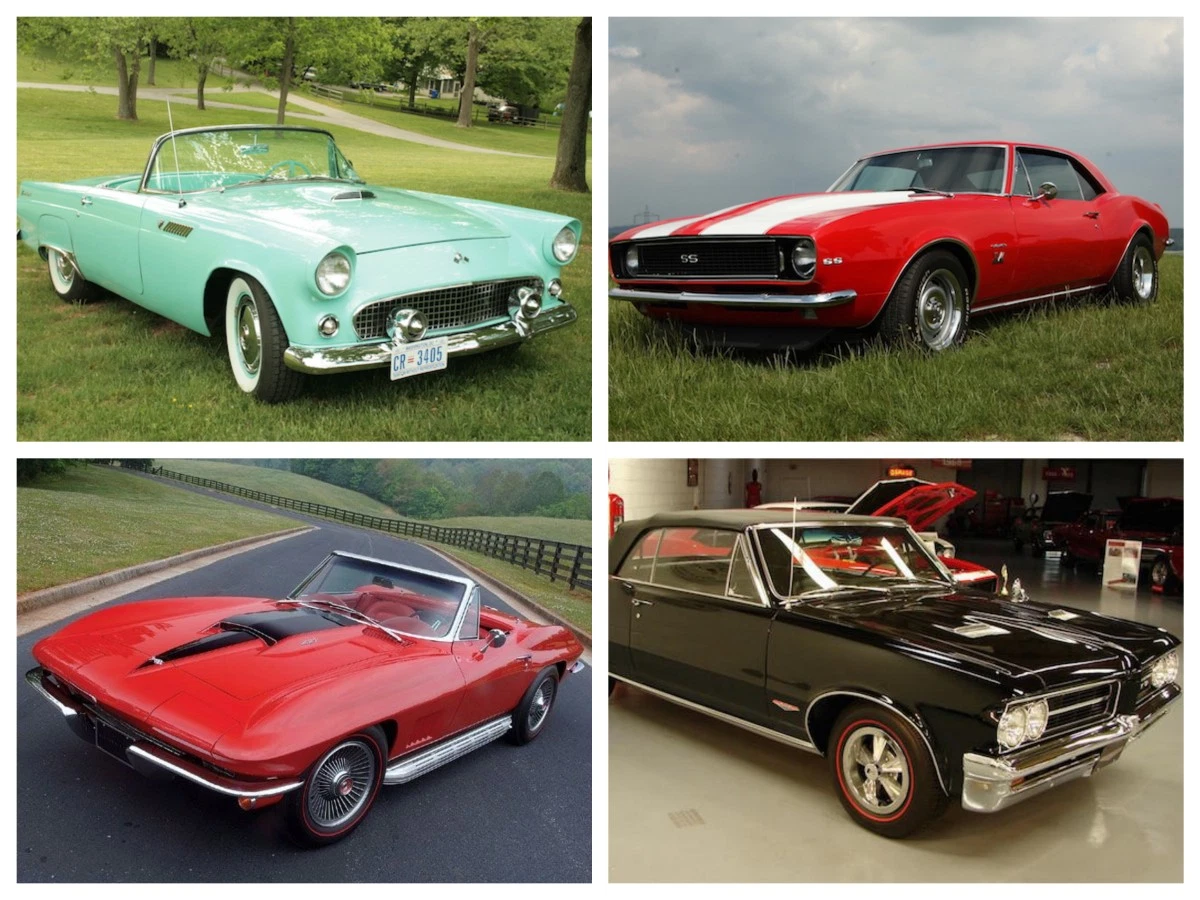
Okay, so let’s just get it out there upfront — there is no real conclusion to this topic, and never will be. It’s largely based on opinion, which differs person to person. That being said, you can gather a good bit by looking at the cars from each decade. Whether you’re looking for an investment or just trying to settle an argument on the topic with fellow enthusiasts, here’s a little unbiased view of each decade’s vehicles.
Automobiles of the 1950s
This decade was pivotal in the history of America. WWII was over, people felt bold and enthusiastic about the future, and the automobile became an American staple. Cars were made to reflect the new attitude — they were built big and fast, with chrome and luxury in abundance.
In 1950, 40 million cars were on the road — a number that would nearly double by the end of the decade. It was during this time that the car would become an integral part of the American lifestyle.
Highlights:
Let’s just get this one out of the way, the 1957 Chevy — you were already thinking about it weren’t you?
Don’t forget that one of the most iconic cars in history, the Corvette, was born in 1953.
What about the glitzy 1953-1954 Buick Skylark? This model was a slam-dunk for sure!
Not to mention the 1956 Continental Mark II — an American car with understated, European style.
The 1955-1957 Ford Thunderbird was a personal luxury car and total head turner.
Automobiles of the 1960s
In the sixties, changes in technology were well underway — as well as social awareness and fashion. These are all elements that reflected the cars made in the era. They were getting sharper, faster, and more rebellious.
It was during this decade that automakers started feeling the push for more options — so subcompacts, compacts, and mid-size cars were born. The public also demanded more power, and thus the muscle car was born.
Highlights:
1967 Chevrolet Corvette Sting Ray
While the 1950s had the Corvette, the 1960s brought up the Corvette Sting Ray, one of the coolest models ever made (arguably).
Click any item to open the gallery carousel
The Ford Mustang, Chevy Camaro, and Pontiac Firebird (and Trans Am for those about to lose their minds), were ALL introduced in the 1960s. So if horsepower is your thing, this fight was just settled.
1969 Pontiac GTO "The Judge"
Both the 1964 GTO and 1969 GTO (A.K.A. the “Judge”) muscled the streets in this decade.
1968 Chevrolet Chevelle
The Chevelle is a car worth noting as being born in the 60s, but didn’t peak until the 70s, so it doesn’t technically count.
Of the cars to buy list, 0 cars from the 1950s made the list, while five from the 60s are listed.
Three 1950s models and five 1960s models are on the sell list.
As far as vehicles to hold go, 10 are models of the 1960s and only six models made this list.
What does this data tell us? Just as an overview, the Dow Jones Investment-Car Index shows us that there’s more interest in models from the 60s, overall. The value of buying into a 1950s model has probably long past, but there’s still much potential there. Although selling your 1950s model may bring in some money as the value of some have peaked — the same can be said for 1960s models though. Lastly, holding onto your 1960s model for a bit longer will probably gain your more money in the long run, while 1950s models may be starting to cost owners more to maintain than they’re worth.
It’s also worth noting that few other year models appeared outside of those from the 50s, 60s, and few appearances from the 70s.
So what’s the definitive answer? As you probably guessed, there isn’t one, it’s all preference. Choose a car that fits your purpose — be it investment, collection, or leisure, and treasure it because cars from these two decades are truly works of art!
About the author
Jason Lancaster
Share your feedback
This article is meant to provide general guidance only. Automotive maintenance, repair, upgrade, and installation may depend on vehicle-specifics such as make and model. Always consult your owner's manual, repair guide for specific information for your particular vehicle and consider a licensed auto-care professional's help as well, particularly for advance repairs.