The first stock component most riders yank off their motorcycle is the exhaust. So adding a new aftermarket motorcycle exhaust is one of the quickest and easiest ways to add horsepower and torque.

A new set of pipes is also a great way to give a motorcycle more character. Best of all, installing a new motorcycle exhaust is easy for do-it-yourself types.
How a Motorcycle Exhaust Works
Let’s start with the very basics of motorcycle exhausts.
Hot gases are created when fuel detonates in an engine’s combustion chamber. Those spent gases are funneled into the motorcycle exhaust pipe. That pipe—metal tubing connected directly to the cylinder head—is appropriately dubbed the header.

An exhaust valve controls the release of those gases from the cylinder head, and an exhaust pulse is created each time the exhaust valve opens and closes. This swirling concoction of gases and energy heads toward the collector. That’s an expanded chamber at the junction where exhaust pipes meet. The shape of the collector and the distance it’s placed away from the cylinder head affect an engine’s power characteristics.
The Exhaust Note
Two things typically happen in the collector—a catalytic conversion of harmful carbon monoxide and initial noise reduction.
The gases then exit out of a butterfly valve that regulates backpressure and helps regulate noise. Backpressure is the amount of resistance in a motorcycle exhaust system. Small-diameter exhaust pipes, mufflers, and motorcycle exhaust baffles affect backpressure. The exhaust gas exits the butterfly valve and then flows to the muffler.

Motorcycle mufflers help keep decibel levels in check and neighbors happy.
A muffler consists of an outer housing and a perforated core wrapped with sound-damping material. As the exhaust gas passes through the core, it dampens the noise before exiting. A motorcycle exhaust might have a baffle, too, which is a perforated metal pipe inserted into the muffler to create back pressure and dampen noise.
Alternative Aftermarket Motorcycle Exhaust Designs
There are exceptions to these basic rules for motorcycle exhausts. For example, some old-school bikers run drag pipes, also called straight pipes, which have nothing inside. Loud and unruly, an open pipe is good if you’re constantly wide open, but tuning them in can be tricky. Also, open pipes often create flat spots in torque curves which don’t benefit street riding.

With dual exhausts, it’s a straight shot for spent gases to exit the cylinder head.
Meanwhile, dual exhausts each have a cylinder head connected to its own exhaust—so gases aren’t funneled into a single collector.
Another type of motorcycle exhaust is two-into-one (2-into-1). That’s an exhaust system where two head pipes converge at a collector and exit through a single muffler. And there are two-into-two (2-into-2) motorcycle exhaust arrangements in which both head pipes have a separate exit. Finally, a four-into-one (4-into-1) system has four head pipes converging into a single pipe, then the collector.

Two-into-one pipes, like this Trask Assault exhaust, meet at a collector before exiting the muffler.
Slip-Ons versus Full Aftermarket Motorcycle Exhaust Systems
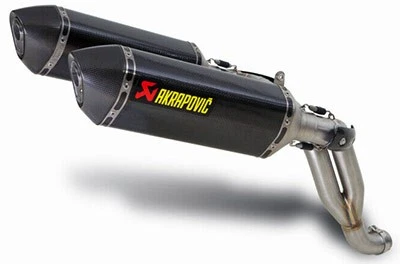
Adding a set of slip-ons is a quick, easy way to add style and power.
A slip-on—also called a bolt-on system—consists of only a new muffler. They slip on a stock header, so it’s a quick install. It’s the easiest way to gain a few ponies for your motorcycle. And it’s also the cheapest.
A full system replaces everything from the headers back. As a result, a complete system provides more significant power gains, enriches the exhaust note, and can liven up the look. But, as you might expect, a full system also costs more.
Aftermarket motorcycle exhaust systems do more than jettison hot gases from the engine. The variables—including exhaust pulses and back pressure—allow riders to finesse performance. They allow chemical conversions to take place and regulate decibels. In recent years, high-end materials like titanium - opens in new window or tab. and carbon fiber have become more commonplace.
The weave of durable carbon fiber exhaust - opens in new window or tab. and the shine of titanium exhaust pipes - opens in new window or tab. are great ways to spice up your motorcycle’s look and performance.
About the author

Share your feedback
This article is meant to provide general guidance only. Automotive maintenance, repair, upgrade, and installation may depend on vehicle-specifics such as make and model. Always consult your owner's manual, repair guide for specific information for your particular vehicle and consider a licensed auto-care professional's help as well, particularly for advance repairs.