Jaguar Celebrates the Iconic D-Type with Summer Road Tour
Performance
Motorsports
Classics
European

Jaguar Classic celebrated the 85th
running of the Le Mans 24-hour endurance race this past weekend at Classic Works, the automaker’s new Coventry-based facility for classic Jaguar owners. That’s where Jaguar displayed its iconic Le Mans winning race cars: the C-Type - opens in new window or tab., D-Type, X-JR-9, and X-JR-12. Sixty years ago, D-Types - opens in new window or tab. took all three steps of the podium at the 24-hour race, as well as fourth- and sixth-place finishes.
“The Le Mans 24-Hours race holds a special place in the hearts of all Jaguar fans. It’s a test of endurance that Jaguar is proud to have won seven times,” said Tim Hannig, director of Jaguar Land Rover Classic. “It’s only right that we celebrate those successes at the opening of Jaguar Land Rover Classic Works, 60 years since the outstanding performances of the D-type cars in 1957.”

The new display at Jaguar Land Rover Classic Works
In the mid-1950s, Jaguar was unstoppable, with three consecutive Le Mans - opens in new window or tab. victories, all thanks to the D-Type. Five D-Types including several of the Le Mans cars will now travel from Coventry to Hampton Court Palace for the Concours of Elegance in early September.
The Birth of the D-Type
The 1950s was the golden era for Jaguar under the tutelage of Sir William Lyons, the company’s founder. Lyons had moved his company to the Browns Lane, Coventry factory in 1951. With the introduction of the XK 120 - opens in new window or tab., Lyons made the decision to validate Jaguar’s sports car performance on the race track. He hired Malcolm Sayer, a stylist with a background in aircraft design to reconfigure the XK’s body, giving birth to the C-Type. The “C” stood for competition. The C-Type podiumed in Le Mans twice, in 1951 and 1953. It was the first car to utilize disc brakes in racing.
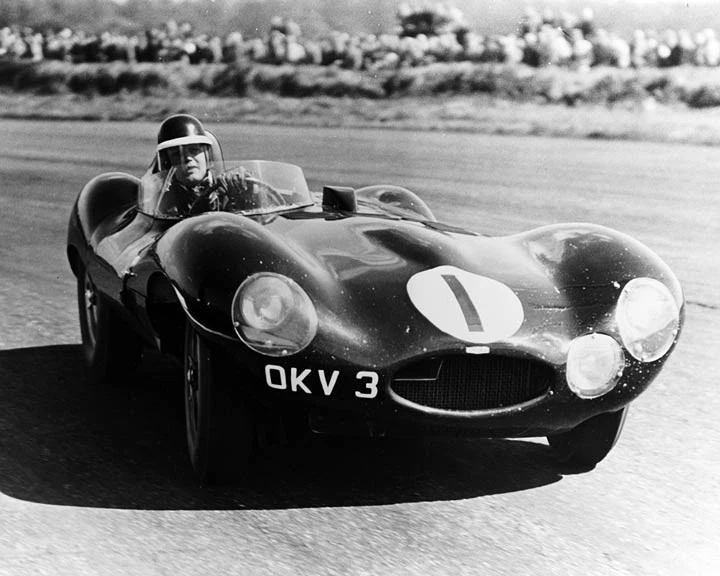
Factory photo of 1955 Jaguar D-Type
Significant as those victories were, Sayer’s best years were yet to come. In 1954 he penned the D-Type, best known for its pioneering use of monocoque construction. Curb weight was a scant 1,854 pounds. By using a rigid shell and small subframe to support the car’s load, Sayer was able to improve over traditional body-on-frame construction, making the car lighter and faster.
The D-Type’s six-cylinder 245-horsepower engine came from the XK 120. A compact double wishbone up front and solid rear axle made up the suspension. The car employed aircraft-inspired Dunlop disc brakes, just like the C-Type that preceded it.
While the D-Type’s racing victories would have been enough for most designers, Malcolm Sayer and his boss, Sir William Lyons, had more magic up their sleeves. In 1957, as the D-Type was sweeping Le Mans, Sayer was at work on a new prototype: the E1A.
Paving the Way for the E-Type

This restored numbers-matching 1961 Jaguar E-Type Roadster is available now on eBay, with a Buy-It-Now price of $399,900.
Jaguar announced that it was working on a new sports racing model on January 21, 1957—less than a month before a fire ripped through the Coventry plant, destroying many of the automaker’s XKSS cars. Jaguar officially withdrew from racing, but Sayer soldiered on, creating a second prototype called the E2A and testing it during practice for the 1960 Le Mans race. Rumors of a new “E-Type” production car began to fly.
In 1961, Jaguar unveiled that car at the Geneva auto show. Jaguar exec Bob Berry had driven the E-Type - opens in new window or tab. flat-out, arriving in Geneva just 20 minutes ahead of the reveal. Media demand for test drives was so high that Jaguar deployed driver Norman Dewis to deliver a second car to the show. Dewis drove through the night and was greeted in Geneva by applause from members of the press.
Jaguar produced the E-Type through 1975. Enzo Ferrari is said to have called it “the most beautiful car ever made,” upon its reveal in Geneva. In 1996, the Museum of Modern Art in New York added an E-Type to its permanent collection.
About the author

Share your feedback
This article is meant to provide general guidance only. Automotive maintenance, repair, upgrade, and installation may depend on vehicle-specifics such as make and model. Always consult your owner's manual, repair guide for specific information for your particular vehicle and consider a licensed auto-care professional's help as well, particularly for advance repairs.