You probably have heard of the Toyota Celica, and you’re undoubtedly familiar with the Toyota Supra. But did you know that for a short period of time those two nameplates lived side-by-side on the same vehicle?
In late 1981, Toyota combined its entry-level Celica with the higher-spec and more powerful Supra coupe in order to create a sporty GT that would serve as the company's flagship in the United States for the next five years.
It was an unusual although inspired move from an automaker that was just beginning to hit its stride with American buyers. The Toyota Celica had been a mini-Mustang pony option with four-cylinder power. The brand attempted to take it up-market by stuffing a large-displacement straight six under an elongated hood towards the end of the 1970s—calling it the Supra. When that strategy failed to make waves, it was time to go all-in by showing US customers that Toyota was capable of more than just building affordable fuel misers.

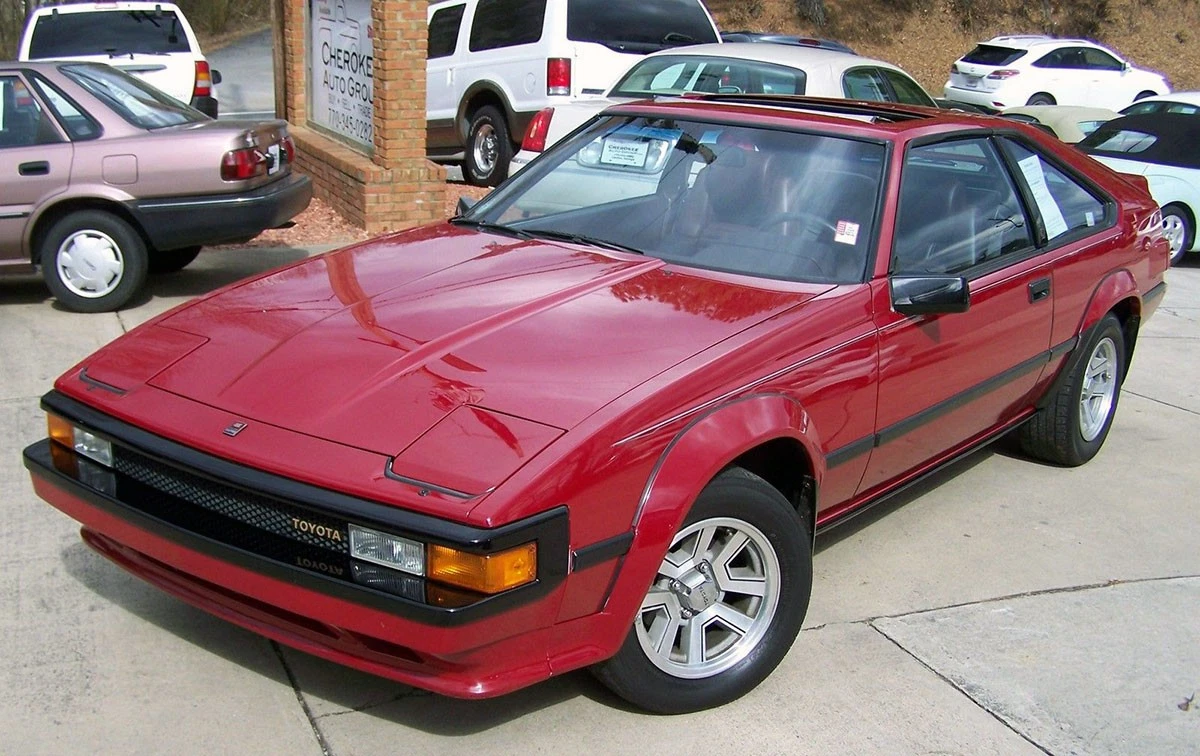
That trailing roof spoiler was unique to the Celica Supra and denoted the P type Performance models. The images in this post are from a Celica Supra listing that ended last month.
The heart of the beast remained a six-cylinder motor, upgraded to a 2.8-liter unit known as the 5M-GE. With 145 horsepower available from its twin-cam design, performance was good for the era, but not staggering. No matter: Toyota matched the engine with a five-speed manual gearbox that attempted to balance efficiency with performance (an automatic transmission was also available). In back, the rear-wheel drive coupe offered a live axle corralled by a semi-trailing arm setup.
On the outside, the Celica Supra shed its previous malaise-era looks and adopted a sharp wedge-shape up front, bulging fender flares at all four corners, and a dramatically plunging rear deck. Pop-up headlights were standard, and if you ordered the P type (for Performance) instead of the L type (for Luxury), you also received a flat spoiler extending the roofline. The interior featured novelties like over-bolstered seats with pump-up lumbar support, as well as ultra-80s gear like a multi-band EQ for your cassette player and one of Toyota's first automatic climate control systems.

Does it get any more 80s than this stereo equalizer setup?
On the road, the Toyota Celica Supra wasn’t exactly athletic, but it could hold its own. With a curb weight of less than 3,000 pounds, it served better in a grand touring role than as a dedicated sports car. By the end of its run, the twin-cam six was pushing out 161 horses and similar levels of torque, which kept it in the running with the paltry output from much larger eight-cylinder lumps found in American muscle of the same vintage. The sprint to 60 miles per hour took just a few ticks over eight seconds, and the quarter mile disappeared in 16.1 seconds with trap speeds matching the 85-mph limit on the Celica Supra's speedometer.
Today, these cars have almost disappeared. The Supra that followed introduced us to the glamour of turbocharging. The generation after that was the gateway to the Fast and Furious fever that swept the import scene in the 1990s. But whereas the fourth-generation Supra has been priced beyond the means of most collectors, the second-gen Celica Supra can be had for between $5,000 and $15,000—with the latter figure likely snagging you the nicest example on the market.
Buy one that’s been maintained, and it will run forever. Buy one that’s been beat up, and it will still run forever. That’s just how Toyotas were built in the 1980s. With most of the car’s mechanicals easily found on other models from the brand, you should not find yourself cursing a bloated repair bill at any point during your ownership of this unique 1980s 2+2.
About the author

Share your feedback
This article is meant to provide general guidance only. Automotive maintenance, repair, upgrade, and installation may depend on vehicle-specifics such as make and model. Always consult your owner's manual, repair guide for specific information for your particular vehicle and consider a licensed auto-care professional's help as well, particularly for advance repairs.