eBay Motors Offers an Original 1938 Harley-Davidson Knucklehead
Motorcycles & ATVs
Motorcycles

Engine patent for 1936 Harley Knucklehead. A print of the patent is available on eBay.
The Knucklehead was Harley-Davidson’s first overhead-valve big twin, and as such, it started a culture that defined the manufacturer ever since. Engine development began in 1931, and Harley introduced the first Knucklehead in 1936. Two years later, the engine was modified, enclosing the valve springs and stems for increased durability. Harley offered two trim lines in 1938—producing about 2,289 bikes labeled EL including this excellent Knucklehead example now listed on eBay Motors, as well as 189 units of the ES. With such low production numbers, any documented ’38 Knucklehead is a good find.
Completely Factory Original
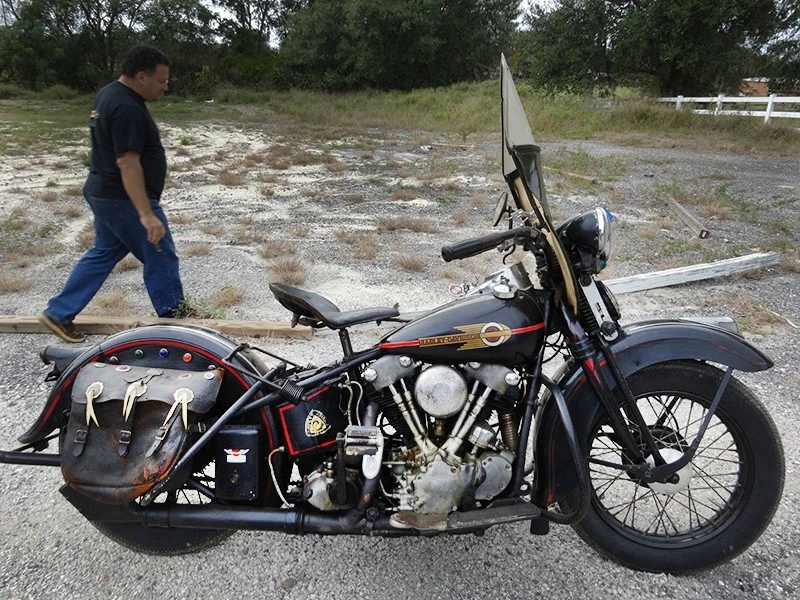
What makes the bike listed on eBay rarer is its original paint—what Harley enthusiast Todd Bertrang, the current owner, abbreviates to “OP.” He says than exhaustive search turned up only about five existing examples. In the world of antique motorcycles and cars, the only thing that trumps a 100-point restoration is a super-clean and unrestored vehicle. While this Knucklehead has undergone some mechanical work, all of the parts including the tanks are NOS or new old stock - opens in new window or tab..
Bertrang compiled a complete history of the bike. He says this Knucklehead was produced towards the end of 1938 when the model was distinguished by its bowed forks. The Zerk connectors are on the outside of the forks, whereas on earlier ’38 models they were located on the inside. The Harley-Davidson dealer that originally sold the bike repossessed it due to lack of payment and repainted the tanks to increase its resale value. The bike didn’t sell, and in about 1990, Dennis Hines bought out the dealership.
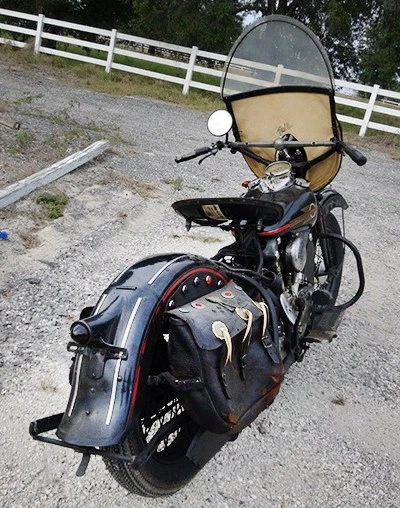
When the Knucklehead’s third owner, George Tunis, purchased the bike from Hines in 2000, he used NOS parts purchased from the Joe Barber collection, including NOS red and black tanks - opens in new window or tab. to return it to its factory-original unrestored condition. This explains why the paint on the tanks looks slightly different than the paint on the fenders - opens in new window or tab..

However small chips in the paint both on the fenders and the tank reveal the brown primer that Harley-Davidson used when the bike was produced. The alligator-skin side saddle bags - opens in new window or tab. are also original correct for 1938. The writing on the back of the seat is also factory original.
The rear brake and both wheels - opens in new window or tab. are NOS. Although the bike was complete when Bertrang, the fourth owner, bought it, mechanical work was needed. “It leaked from everywhere,” said Bertrang. So he disassembled the machine and restored it to good running order.

Big Twin Power
The Knucklehead’s big twin engine was the first in which Harley-Davidson used a recirculating oil system, making the engine capable of harder use and increasing its reliability in extreme temperatures (because the oiling system could cool the hottest parts). A single, four-lobe camshaft was gear-driven from the crankshaft. The engine heads and cylinders were made of cast iron—a material favored by foundries at the time because it was easy to cast. Fins on the heads improved airflow to keep the engine cool. The crankcase was cast aluminum.

In addition to enclosing the valves, Harley-Davidson made other improvements during the Knucklehead’s tenure, including stiffer valve springs and splined oil-pump drive gears and an increased cylinder bore to boost the engine’s power.
Nonetheless, the writing was on the wall for the Knucklehead. New Post-War roads that were wider and faster meant it was time for a new machine. The Marshall plan and its reduced tariffs on materials such as aluminum made it possible for Harley-Davidson to design its new model from a clean sheet of paper.

Harley-Davidson produced the Knucklehead until 1947 when that model was replaced by the Post-War Panhead - opens in new window or tab. in 1948. The Panhead—named for the unusual shape of its rocker covers—was, in turn, replaced in 1965 by the Shovelhead - opens in new window or tab.. By that time, the big twin engine had become enshrined as a vital part of America’s motorcycle culture.
About the author

Share your feedback
This article is meant to provide general guidance only. Automotive maintenance, repair, upgrade, and installation may depend on vehicle-specifics such as make and model. Always consult your owner's manual, repair guide for specific information for your particular vehicle and consider a licensed auto-care professional's help as well, particularly for advance repairs.