
This year Indianapolis celebrates the centennial running of the 500 with several weeks of activities - opens in new window or tab. including practice, qualifying, carburetion day, and the race itself on Sunday May 29. The momentous occasion is a chance to explore some of the most fascinating Indianapolis racing trivia.
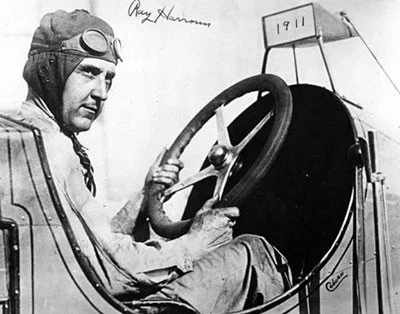
Photo of Ray Harroun.
For example, did you know that mechanic Ray Harroun - opens in new window or tab. won the first race in 1911, averaging 74.6 miles-per-hour and finishing in 6:42.1? Fellow drivers criticized Harroun for not having a riding mechanic, but Harroun wisely installed a more important safety device: the first rearview mirror. During that race, Sam Dickson, riding mechanic for Arthur Greiner, became the race’s first fatality when a wheel came off the American Simplex race car causing Greiner to lose control. Dickson was thrown into a fence 20 feet away and died instantly. (Joe Dawson, pictured at the top of this page, won in 1912.)
Racing was suspended twice, during World War I and World War II, explaining the discrepancy between the inaugural event and the centennial.
The Duesenberg - opens in new window or tab. brothers dominated the race in the early 1920s, winning in 1922, 1924, and 1925. Two of those wins came from the race’s first supercharged cars, the second of which broke the 100 mile-per-hour average speed barrier. When Eddie Rickenbacker purchased the track in 1927, he succumbed to complaints by other manufacturers, prohibiting supercharging and increasing maximum engine displacement size to 366 cubic inches.

Photo of Wilbur Shaw.
In 1935, Fred Offenhauser and Leo Gossen secured their first Indy 500 victory. The Offy - opens in new window or tab. four-cylinder engine went on to win the race 27 times, dominating American open-wheel racing for half a century.
Wilbur Shaw was the first driver to win two consecutive Indy 500 races in 1939 and 1940. He purchased the track from Rickenbacker in 1945 for $750,000.
Louis Meyer - opens in new window or tab. started the tradition of drinking milk to celebrate a victory after his second Indy 500 win in 1933. When Meyers requested buttermilk after his third win, a local dairy executive saw a marketing opportunity and vowed that the winner would be given milk the following year. Today winners choose between whole, two percent and skim milk. The bottles engraved with the words “Indianapolis 500 Winner” are trophies unto themselves.

Photo of Louis Meyer
Tony Ruttman was the youngest Indianapolis 500 winner at age 20 in 1952. Al Unser - opens in new window or tab., one of four drivers to win the race four times, was the oldest, capturing the checkered flag in 1987 at age 47.
Rick Mears - opens in new window or tab., who also claimed four Indy 500 victories, holds the record for the most pole positions—six to be exact. AJ Foyt - opens in new window or tab., the third driver to win four times also holds the record for the most distance covered during Indianapolis 500 races: 4,909 laps (12,272.5 miles).
Seven women have qualified to race the Indianapolis 500, beginning with Janet Guthrie in 1997. Lyn St. James - opens in new window or tab. is the only female driver to win Indianapolis 500 Rookie of the Year. Danica Patrick placed third in 2009: the best finish by a woman driver.
The hottest recorded temperature at an Indy 500 race was 92 degrees in 1937 when Wilbur Shaw won the race. Al Unser Jr. won the coldest recorded Indianapolis 500 in 1992 when temperatures hovered at 52 degrees. The longest rain delay took place in 1986, when storms washed out the race on Sunday May 25 and again the following day. The race was rescheduled and successfully run on May 31.

Signed photo of Al Unser Jr.
Penske drivers Al Unser Jr. - opens in new window or tab. and Emerson Fittipaldi - opens in new window or tab. get the nod for two of the most interesting wins, with each losing to his teammate after crashing during the final 100 miles of the race. In 1989, Unser Jr. was leading on lap 199 when his car touched wheels with Fittipaldi’s coming out of Turn 3. Unser spun out and crashed into the outside wall, giving Emo the win under a yellow flag. In 1994, Fittipaldi attempted to pass Unser Jr. while leading in lap 184. Coming out of Turn 4, Fittipaldi’s left wheels touched the inside rumble strips, causing the back of his car to break loose and tag the outside wall. With Fittipaldi out of the race, Unser Jr. took the checkered flag.
About the author

Share your feedback
This article is meant to provide general guidance only. Automotive maintenance, repair, upgrade, and installation may depend on vehicle-specifics such as make and model. Always consult your owner's manual, repair guide for specific information for your particular vehicle and consider a licensed auto-care professional's help as well, particularly for advance repairs.