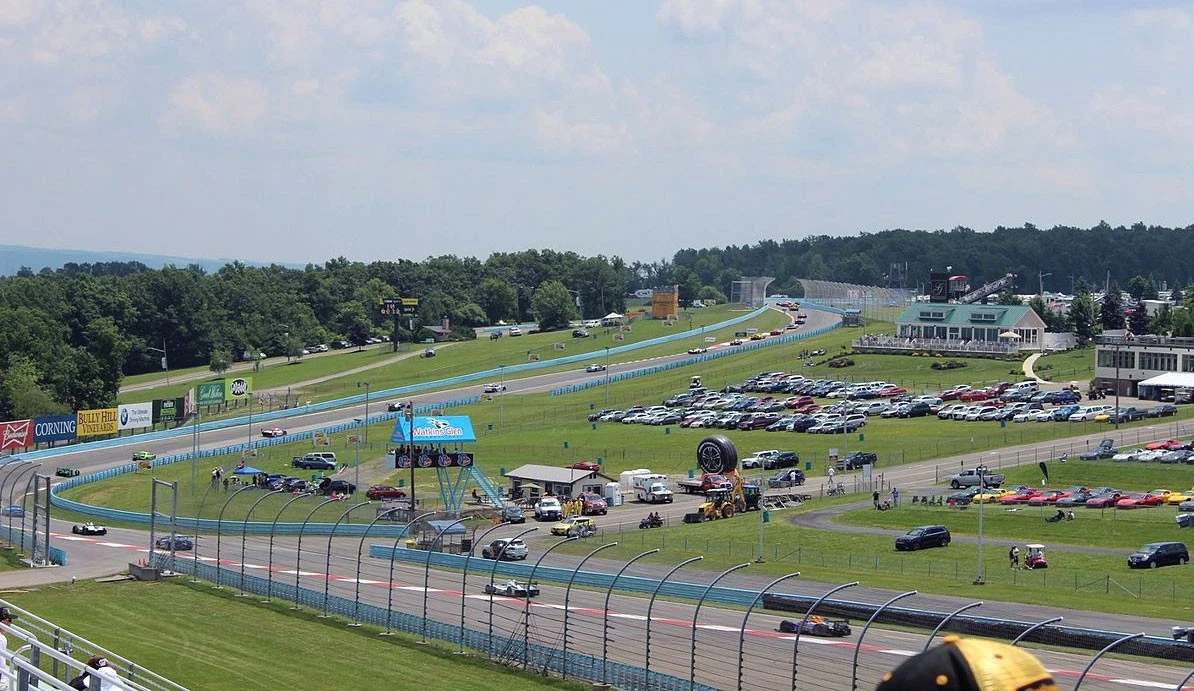
Like so many world-class motorsports facilities, Watkins Glen International began on the streets and bucolic roadways surrounding the racing venue that serves as its namesake. The early races in the small New York town were organized starting in 1948 by local resident Cameron Argetsinger, who wanted to bring European road racing to the United States. The locale would become host to the SCCA-sanctioned Watkins Glen Grand Prix, which ran on a 6.6-mile long course directly through the small burg.
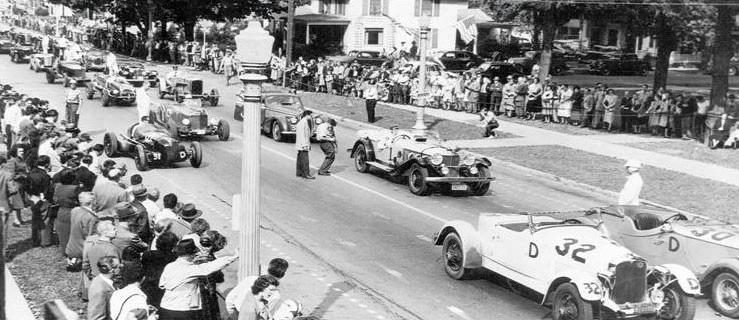
1948 Junior Grand Prix. Cameron Argetsinger's dream became reality on October 2, 1948, in the first post-World War II road race in the US. (Image at top of page is by Pstark1, courtesy of wikimedia)
By the early 1950s, however, it became clear to custodians of the event that crowd safety was getting out of hand. This was driven home by an accident during the Grand Prix of 1952 in which one spectator was killed and several others injured when a car left the course at speed. The interim solution was to move the event to the nearby town of Dix, where a slightly shorter course was run between 1953 and 1955—again on public roads but eventually sanctioned by a reluctant SCCA amidst complaints about faulty track conditions.
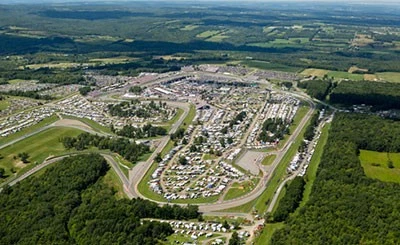
The interim track formed the bones of The Glen that would survive to the modern era. The facility broke ground soon after the 1955 season was over, and by 1956 it took the form of a 2.3-mile road course that was set entirely on private land. The first outside series to test out the new facility was NASCAR's Grand National division in 1957, followed swiftly by Formula 1—which would make Watkins Glen its US home for two decades—with the racing calendar augmented by CART Indy car, Trans-Am, and Can-Am.
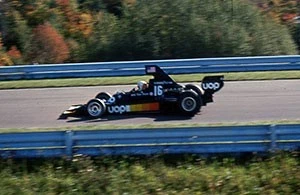
By rjbfspso@sbcglobal.net, courtesy of wikimedia.
The year 1971 brought a significant redesign of the track that would shape it into the course we know today. That renovation included adding a series of turns known as “The Boot” that would stretch the overall length of The Glen. Over time, other modifications were made to enhance safety, maximize spectator enjoyment, and meet the requirements of several racing organizations. This included the installation of the Scheckter chicane, the permanent “bus-stop” chicane, and the “inner loop” chicane—each of which was intended to slow down the increasingly faster cars, which gained speed from the so-called ground-effect (enhanced aerodynamics) era of motorsport. In the intervening decades, there were also efforts widen and re-pave, and to relocate certain track fixtures.
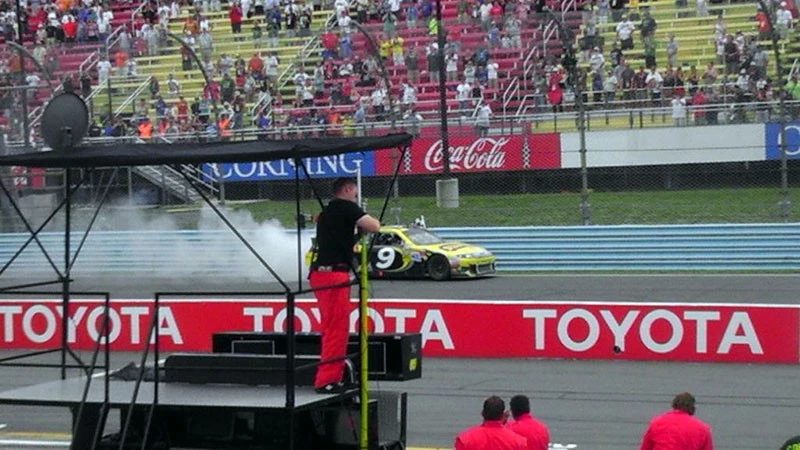
By Mo2010 , courtesy of wikimedia.
Today Watkins Glen International is wholly owned by International Speedway Corporation, which partnered with Corning Enterprises in the early 1980s to revitalize the track. Still host to NASCAR in one of the most exciting dates on the Cup schedule, and now offering some of the most exciting vintage racing in America, The Glen continues to shine as one of the premier motorsports destinations in the country.
About the author

Share your feedback
This article is meant to provide general guidance only. Automotive maintenance, repair, upgrade, and installation may depend on vehicle-specifics such as make and model. Always consult your owner's manual, repair guide for specific information for your particular vehicle and consider a licensed auto-care professional's help as well, particularly for advance repairs.