Picture 1 of 1
Stock photo

Picture 1 of 1
Stock photo
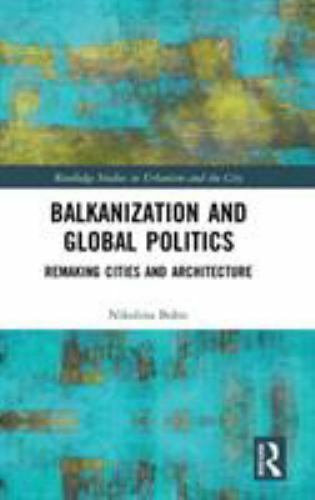
Routledge Studies in Urbanism and the City Ser.: Balkanization and Global Politics : Remaking Cities and Architecture by Nikolina Bobic (2019, Hardcover)

Great Book Prices Store (364171)
98.1% positive feedback
Price:
$206.65
Free shipping
Returns:
14 days returns. Buyer pays for return shipping. If you use an eBay shipping label, it will be deducted from your refund amount.
Condition:
Countries, cities and regions are ever increasingly voicing the desire for independence and balkanization from the nation or union they are a part of.
- Buy It NowBalkanization and Global Politics : Remaking Cities and Architecture, Hardcov...
Oops! Looks like we're having trouble connecting to our server.
Refresh your browser window to try again.
About this product
Product Identifiers
PublisherRoutledge
ISBN-101138061832
ISBN-139781138061835
eBay Product ID (ePID)248455463
Product Key Features
Number of Pages212 Pages
Publication NameBalkanization and Global Politics : Remaking Cities and Architecture
LanguageEnglish
Publication Year2019
SubjectEarth Sciences / Geography, General, World / European
TypeTextbook
AuthorNikolina Bobic
Subject AreaPolitical Science, Science
SeriesRoutledge Studies in Urbanism and the City Ser.
FormatHardcover
Dimensions
Item Height0.7 in
Item Weight16.8 Oz
Item Length9.2 in
Item Width6.3 in
Additional Product Features
Intended AudienceCollege Audience
LCCN2018-054356
Reviews"Dissecting the territorial disintegration experienced in Yugoslavia, Nikolina Bobic demonstrates the ways that the militaristic and financial strategies of global capitalism at times intersect with architecture, infrastructure, and urban ideologies. Contemporary balkanization is presented as part of the process of de-and reconstruction of subjectivity attuned with the spectacle of global media, at the expense of manifold layers of historical memories of a place. A timely excursion into the conceptual terrains of balkanization which has achieved a new currency under the rubric of Brexit and the nationalism permeating current Anglo-Saxon geopolitics."-- Gevork Hartoonian, Professor of the History and Theory of Architecture, University of Canberra "Balkanization and Global Politicsis a powerful inquiry into the way global politics are enacted spatially through architecture and urban design. It is also a detailed investigation of the fate of the states in years of bloodshed that followed the break-up of the former Yugoslavia and the high price in loss of freedom they paid in the name of stability. Far from a localized history, this book argues that what happened in the Balkans - which we know today by the word Balkanization - could happen anywhere." -- Ian Buchanan, Professor of Cultural Studies, University of Wollongong lso a detailed investigation of the fate of the states in years of bloodshed that followed the break-up of the former Yugoslavia and the high price in loss of freedom they paid in the name of stability. Far from a localized history, this book argues that what happened in the Balkans - which we know today by the word Balkanization - could happen anywhere." -- Ian Buchanan, Professor of Cultural Studies, University of Wollongong, "Dissecting the territorial disintegration experienced in Yugoslavia, Nikolina Bobic demonstrates the ways that the militaristic and financial strategies of global capitalism at times intersect with architecture, infrastructure, and urban ideologies. Contemporary balkanization is presented as part of the process of de-and reconstruction of subjectivity attuned with the spectacle of global media, at the expense of manifold layers of historical memories of a place. A timely excursion into the conceptual terrains of balkanization which has achieved a new currency under the rubric of Brexit and the nationalism permeating current Anglo-Saxon geopolitics."-- Gevork Hartoonian, Professor of the History and Theory of Architecture, University of Canberra, Australia, "Dissecting the territorial disintegration experienced in Yugoslavia, Nikolina Bobic demonstrates the ways that the militaristic and financial strategies of global capitalism at times intersect with architecture, infrastructure, and urban ideologies. Contemporary balkanization is presented as part of the process of de-and reconstruction of subjectivity attuned with the spectacle of global media, at the expense of manifold layers of historical memories of a place. A timely excursion into the conceptual terrains of balkanization which has achieved a new currency under the rubric of Brexit and the nationalism permeating current Anglo-Saxon geopolitics." -- Gevork Hartoonian, Professor of the History and Theory of Architecture, University of Canberra, Australia "Balkanization and Global Politics is a powerful inquiry into the way global politics are enacted spatially through architecture and urban design. It is also a detailed investigation of the fate of the states in years of bloodshed that followed the break-up of the former Yugoslavia and the high price in loss of freedom they paid in the name of stability. Far from a localized history, this book argues that what happened in the Balkans - which we know today by the word Balkanization - could happen anywhere." -- Ian Buchanan, Professor of Cultural Studies, University of Wollongong, Australia "A timely, well-researched and well-crafted book that not only analyses the concepts of 'Balkanism' and 'Balkanisation' but provides a detailed overview of the disintegration of the Yugoslav state from an architectural and urban perspective. Emphasising that urbanism and architecture cannot be dislocated from social history and politics, Nikolina Bobic draws upon extensive research and relevant case studies in Serbia, Croatia and Bosnia & Herzegovina to underpin a powerful and compelling narrative. The book will be vital reading for scholars and students of modern Southeast European history, urbanism and architecture, spatial violence and spatial remaking. It is, moreover, equally vital for those seeking to understand the contemporary rise of nationalism, populism and broader historical and evolving geopolitical trends." -- Kenneth Morrison, Professor of Modern Southeast European History, De Montfort University, United Kingdom "A fascinating and original discussion which encompasses both architecture and urbanism in the Balkans, alongside an important interrogation of geopolitical processes of balkanization." -- Anna Minton, Reader in Architecture, UEL, author of Big Capital: Who is London for?, United Kingdom
Dewey Edition23
IllustratedYes
Dewey Decimal320.9497
Table Of Content1. Setting the Framework: Balkan(ization) and Global Politics 2. Balkanism and Balkanization: Fragmentation, Grouping and Excess 3. Yugoslavia In Balkanization: Beyond Civil War, Beyond Ethnonationalism 4. Allied Operations: Present-Future Partnerships of Humanitarianism, Peace and Victory 5. Circulating Violence: Decomposition, Dispossession and Control 6. Territorializations: Transitions, Thresholds and Transgressions 7. Present Spaces, Present Times: Other Spaces, Other Times
SynopsisBalkanization (territorial fragmentation) is becoming a significant urban and geopolitical pursuit in contemporary times. Countries, cities and regions are ever increasingly voicing the desire for independence and balkanization from the nation or union they are a part of. This monograph generally maps the historical and theoreticalemergence of balkanization, as well its more recent spread into fields as far ranging as law, medicine, data and security studies, sociology, architecture and the urban.The spatialization of balkanization is particularly addressed in terms of destruction and renewal through a detailed sociopolitical interrogation of architecture and the urban, including their changing symbolic, ideological and functional forms. The spatial connections between balkanization, violent remaking (destruction and renewal) and global politics have predominantly been analyzed via the former Yugoslav context and the Balkans, however, spotlight has also been directed to the current political climate of the UK, Australia and the Anglo-Saxon geopolitics.The analysis helps in understanding broader emergent patterns of sociospatial polarization across various scales, and in respect to global geoeconomic and geopolitical restructuring. This is particularly important because drawing connections between balkanization, economics, law, media and technology is to gain an awareness of - and engagement with - the emerging implications of spatial remaking and global politics. This monograph is a valuable resource and will be relevant to academics and students interested in spatial politics; including architecture, urbanism, geography, sociology, politics, international development, conflict, and cultural studies., In a world where ever-increasingly countries, states, cities and regions are voicing or declaring independence from the actual country or union they are a part of, it seems that decentralisation - that is Balkanization - is gaining momentum. The concept of Balkanisation plays with both resistance, referring to specific cultural-spatial practices and experience of forces largely beyond control. This book explores the processes of destruction and renewal through a detailed socio-political interrogation of architecture and its changing symbolic and functional forms. It offers a reflective and critical engagement with the recent history of the Balkans understood through a reworking of the concept of Balkanisation. Through a focus on the recent history of Belgrade, it examines the implications of violent remaking in the context of globalisation.
LC Classification NumberDR48.6
All listings for this product

Be the first to write a review


