Picture 1 of 1
Stock photo

Picture 1 of 1
Stock photo
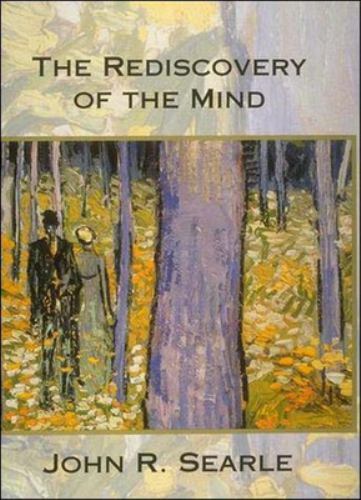
Rediscovery of the Mind by John R. Searle (1992, Trade Paperback)

Cycle Books (2194)
98.4% positive feedback
Price:
$30.16
Free shipping
Returns:
30 days returns. Buyer pays for return shipping. If you use an eBay shipping label, it will be deducted from your refund amount.
Condition:
The Rediscovery of the Mind (Representation and Mind). Title : The Rediscovery of the Mind (Representation and Mind). Authors : Searle, John R. Amazon Subcategory : Consciousness & Thought Philosophy.
- Buy It NowThe Rediscovery of the Mind (Representation and Mind), Searle, John R., New Book
Oops! Looks like we're having trouble connecting to our server.
Refresh your browser window to try again.
About this product
Product Identifiers
PublisherMIT Press
ISBN-10026269154X
ISBN-139780262691543
eBay Product ID (ePID)20038270913
Product Key Features
Book TitleRediscovery of the Mind
Number of Pages286 Pages
LanguageEnglish
TopicCognitive Psychology & Cognition
Publication Year1992
IllustratorYes
GenrePsychology
AuthorJohn R. Searle
Book SeriesRepresentation and Mind Ser.
FormatTrade Paperback
Dimensions
Item Height0.7 in
Item Weight13 Oz
Item Length9.1 in
Item Width6.3 in
Additional Product Features
Intended AudienceTrade
LCCN92-012747
Dewey Edition20
TitleLeadingThe
Grade FromCollege Graduate Student
Dewey Decimal128.2
SynopsisIn this major new work, John Searle launches a formidable attack on current orthodoxies in the philosophy of mind. More than anything else, he argues, it is the neglect of consciousness that results in so much barrenness and sterility in psychology, the philosophy of mind, and cognitive science- there can be no study of mind that leaves out consciousness. What is going on in the brain is neurophysiological processes and consciousness and nothing more-no rule following, no mental information processing or mental models, no language of thought, and no universal grammar. Mental events are themselves features of the brain, "like liquidity is a feature of water." Beginning with a spirited discussion of what's wrong with the philosophy of mind, Searle characterizes and refutes the philosophical tradition of materialism. But he does not embrace dualism. All these "isms" are mistaken, he insists. Once you start counting types of substance you are on the wrong track, whether you stop at one or two. In four chapters that constitute the heart of his argument, Searle elaborates a theory of consciousness and its relation to our overall scientific world view and to unconscious mental phenomena. He concludes with a criticism of cognitive science and a proposal for an approach to studying the mind that emphasizes the centrality of consciousness to any account of mental functioning. In his characteristically direct style, punctuated with persuasive examples, Searle identifies the very terminology of the field as the main source of truth. He observes that it is a mistake to suppose that the ontology of the mental is objective and to suppose that the methodology of a science of the mind must concern itself only with objectively observable behavior; that it is also a mistake to suppose that we know of the existence of mental phenomena in others only by observing their behavior; that behavior or causal relations to behavior are not essential to the existence of mental phenomena; and that it is inconsistent with what we know about the universe and our place in it to suppose that everything is knowable by us., In this major new work, John Searle launches a formidable attack on current orthodoxies in the philosophy of mind. More than anything else, he argues, it is the neglect of consciousness that results in so much barrenness and sterility in psychology, the philosophy of mind, and cognitive science: there can be no study of mind that leaves out consciousness. What is going on in the brain is neurophysiological processes and consciousness and nothing more--no rule following, no mental information processing or mental models, no language of thought, and no universal grammar. Mental events are themselves features of the brain, "like liquidity is a feature of water." Beginning with a spirited discussion of what's wrong with the philosophy of mind, Searle characterizes and refutes the philosophical tradition of materialism. But he does not embrace dualism. All these "isms" are mistaken, he insists. Once you start counting types of substance you are on the wrong track, whether you stop at one or two. In four chapters that constitute the heart of his argument, Searle elaborates a theory of consciousness and its relation to our overall scientific world view and to unconscious mental phenomena. He concludes with a criticism of cognitive science and a proposal for an approach to studying the mind that emphasizes the centrality of consciousness to any account of mental functioning. In his characteristically direct style, punctuated with persuasive examples, Searle identifies the very terminology of the field as the main source of truth. He observes that it is a mistake to suppose that the ontology of the mental is objective and to suppose that the methodology of a science of the mind must concern itself only with objectively observable behavior; that it is also a mistake to suppose that we know of the existence of mental phenomena in others only by observing their behavior; that behavior or causal relations to behavior are not essential to the existence of mental phenomena; and that it is inconsistent with what we know about the universe and our place in it to suppose that everything is knowable by us., In this major new work, John Searle launches a formidable attack on current orthodoxies in the philosophy of mind.
LC Classification NumberBD418.3.S43 1992
All listings for this product


Be the first to write a review