Picture 1 of 1
Stock photo

Picture 1 of 1
Stock photo

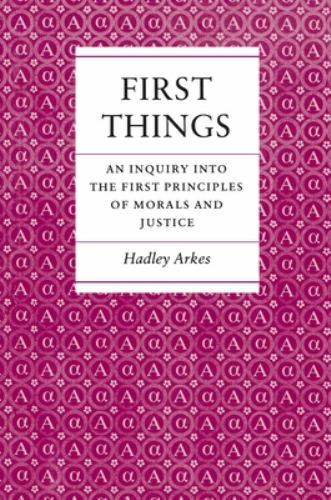
First Things : An Inquiry into the First Principles of Morals and Justice by Hadley Arkes (1986, Trade Paperback)

Prepbooks (240182)
99.6% positive feedback
Price:
$62.50
Returns:
30 days returns. Buyer pays for return shipping. If you use an eBay shipping label, it will be deducted from your refund amount.
Condition:
Number of Pages: 447. Weight: 1.36 lbs. Publication Date: 1986-08-21. Publisher: PRINCETON UNIV PR.
- Buy It NowFirst Things: An Inquiry Into The First Principles Of Morals And Justice
Oops! Looks like we're having trouble connecting to our server.
Refresh your browser window to try again.
About this product
Product Identifiers
PublisherPrinceton University Press
ISBN-10069102247X
ISBN-139780691022475
eBay Product ID (ePID)20038625530
Product Key Features
Number of Pages448 Pages
LanguageEnglish
Publication NameFirst Things : an Inquiry Into the First Principles of Morals and Justice
SubjectEthics & Moral Philosophy, Political
Publication Year1986
TypeTextbook
Subject AreaPhilosophy
AuthorHadley Arkes
FormatTrade Paperback
Dimensions
Item Height1 in
Item Weight24.5 Oz
Item Length9.4 in
Item Width7.6 in
Additional Product Features
Intended AudienceCollege Audience
LCCN85-043267
Dewey Edition19
Reviews"Here [Arkes] shows an unusual grasp of everyday realities. A sharp, savvy argument for quasi-eternal verities in a relativistic world." -- Philadelphia Inquirer, First Things is, without question, an important essay in moral philosophy. . . . A powerful counterattack on the decayed, sophistic moral reasoning of our time., Here [Arkes] shows an unusual grasp of everyday realities. A sharp, savvy argument for quasi-eternal verities in a relativistic world., First Things is, without question, an important essay in moral philosophy. . . . A powerful counterattack on the decayed, sophistic moral reasoning of our time. -- Crisis, Here [Arkes] shows an unusual grasp of everyday realities. A sharp, savvy argument for quasi-eternal verities in a relativistic world. -- Philadelphia Inquirer, " First Things is, without question, an important essay in moral philosophy. . . . A powerful counterattack on the decayed, sophistic moral reasoning of our time."-- Crisis, "Here [Arkes] shows an unusual grasp of everyday realities. A sharp, savvy argument for quasi-eternal verities in a relativistic world."-- Philadelphia Inquirer, " First Things is, without question, an important essay in moral philosophy. . . . A powerful counterattack on the decayed, sophistic moral reasoning of our time." -- Crisis
Dewey Decimal170
SynopsisThis book restores to us an understanding that was once settled in the "moral sciences" that there are propositions, in morals and law, which are not only true but which cannot be otherwise. It was understood in the past that, in morals or in mathematics, our knowledge begins with certain axioms that must hold true of necessity; that the principles drawn from these axioms hold true universally, unaffected by variations in local "cultures"; and that the presence of these axioms makes it possible to have, in the domain of morals, some right answers. Hadley Arkes restates the grounds of that older understanding and unfolds its implications for the most vexing political problems of our day. The author turns first to the classic debate between Abraham Lincoln and Stephen Douglas. After establishing the groundwork and properties of moral propositions, he traces their application in such issues as selective conscientious objection, justifications for war, the war in Vietnam, a nation's obligation to intervene abroad, the notion of supererogatory acts, the claims of "privacy," and the problem of abortion., This book restores to us an understanding that was once settled in the "moral sciences": that there are propositions, in morals and law, which are not only true but which cannot be otherwise. It was understood in the past that, in morals or in mathematics, our knowledge begins with certain axioms that must hold true of necessity; that the principle, This book restores to us an understanding that was once settled in the "moral sciences": that there are propositions, in morals and law, which are not only true but which cannot be otherwise. It was understood in the past that, in morals or in mathematics, our knowledge begins with certain axioms that must hold true of necessity; that the principles drawn from these axioms hold true universally, unaffected by variations in local "cultures"; and that the presence of these axioms makes it possible to have, in the domain of morals, some right answers. Hadley Arkes restates the grounds of that older understanding and unfolds its implications for the most vexing political problems of our day. The author turns first to the classic debate between Abraham Lincoln and Stephen Douglas. After establishing the groundwork and properties of moral propositions, he traces their application in such issues as selective conscientious objection, justifications for war, the war in Vietnam, a nation's obligation to intervene abroad, the notion of supererogatory acts, the claims of "privacy," and the problem of abortion.
LC Classification NumberHM216.A65 1986
All listings for this product


Be the first to write a review


